Documentation
An Ewon Cosy alternative: industrial remote maintenance without a dedicated box
Fixing a machine installed at a customer site, without travelling and without asking anything of the site firewall: that is the need that made remote-maintenance routers like the Ewon Cosy successful. VIGIL-MESH answers the same need with a software agent instead of a box: a Windows or Linux machine on the machine network — the industrial PC that is, more often than not, already in the cabinet — joins an end-to-end encrypted private network with no inbound port, and your technicians reach the PLC, the HMI and the supervision as if they were on site. This page compares the two models honestly, then walks through the migration from an integrator's point of view.
What the Ewon Cosy does very well
The Ewon Cosy, from HMS Networks, has become a de facto standard among machine integrators and builders. The model is crystal clear: a remote-maintenance router in the electrical cabinet establishes an outbound VPN tunnel to the vendor's cloud (Talk2M); the technician connects from their side, and the cloud brings the two ends together. The customer's firewall has nothing to open, the electrician knows how to wire the box, and the service team reaches the machine on commissioning day.
A box designed for the cabinet
DIN rail, industrial power supply, a clean separation between the machine network and the factory network: the Cosy is as much an electrician's product as an IT product, and it fits into the electrical drawing like any other component.
Nothing to ask of the customer's IT
The tunnel leaves outbound towards the vendor's cloud: no inbound port, no port forwarding, no meeting with the site's IT department. That is the argument that converted an entire profession.
A mature ecosystem
Extensive documentation, resellers, established habits in engineering offices: the box + cloud + licences model has been proven for years, and that maturity has real value.
- A machine without an OS and no PC on the machine network. The VIGIL-MESH agent is software: it needs an operating system to run. If the machine network contains only a bare PLC and nothing allows adding a Linux or Windows machine to it, the dedicated box remains the natural solution.
- The need for an integrated 4G router. On a site with no wired internet access, a box that also acts as a cellular router provides two services in one. VIGIL-MESH does not provide connectivity: it travels over it.
- A customer policy that mandates hardware. Some clients require a physical remote-maintenance device, identified on the electrical drawing and physically unpluggable. That is a legitimate policy, and software does not answer it.
The box + cloud model, and what it implies at fleet scale
Nothing below is a hidden flaw: it is the stated way a remote-maintenance router backed by its vendor's cloud works, and it serves its use case very well. But when the fleet grows from five machines to fifty, the consequences of the model become cost and management items in their own right.
- One box per machine or per site. Every cabinet gets its hardware: to buy, stock, wire, provision, and replace on failure. The logistics grow linearly with the fleet — including for machines whose cabinet already contains an industrial PC.
- Access is a tunnel to one box at a time. The technician opens a session to one machine, then closes it and opens another. The fleet is not a network you walk through: it is a list of tunnels you work down.
- The path goes through the vendor’s cloud. Tunnels are established towards its infrastructure, which brings the two ends together. Access to your machines therefore depends on the availability and rules of an external service — for that service’s exact guarantees, the vendor’s documentation is the authority.
- Licences and accounts managed at the vendor. Who reaches what lives in the vendor’s portal, according to its commercial model. That is coherent — but it is not a rule of your network.
The VIGIL-MESH approach: the gateway is software
VIGIL-MESH replaces the box with a software agent — available for Windows, Linux, Android and NVIDIA Jetson, plus a browser node (WASM) to intervene with nothing installed. Installed on a machine of the machine network — the HMI’s industrial PC, a Linux box, a Jetson —, the agent turns that machine into a site gateway: it joins your private network through a single outbound connection and relays the authorized flows to the PLC, which does not change by one byte. The details of this setup are described in Remote access to a PLC.
A real LAN, not a pile of tunnels
All site gateways and technician workstations are members of one private network: every machine has a stable address and a MagicDNS name, and discovery and multicast work between members. The fleet is walked through like a local network.
End-to-end encrypted, blind relays
Sessions are end-to-end encrypted QUIC/TLS 1.3 connections with a hybrid post-quantum key exchange. When a relay is needed, the vigie carries opaque packets without holding the keys — and you can host your own private vigie.
Identity ACLs, audit, MFA
Deny by default: this service group reaches this gateway on these ports, and nothing else. Every access is logged, accounts are protected with MFA, and revoking a technician or a machine is immediate.
SSH terminal in the browser
From the console, an SSH terminal opens on the gateway right in the page: the browser becomes a mesh node, and your credentials never transit our servers.
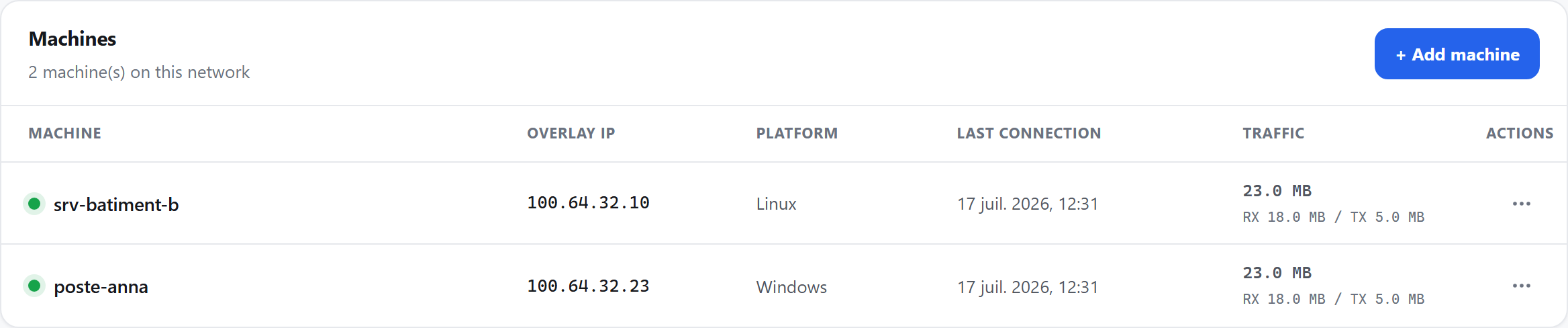
- The site gateway, with the green dot: it is online, reachable by authorized members.
- Its stable overlay address, the same wherever the machine is — this is what your tools target.
- Actions: rename, suspend or revoke the machine — revocation is immediate.
Qualitative comparison
| Criterion | Ewon Cosy + Talk2M | VIGIL-MESH |
|---|---|---|
| Hardware required | A dedicated box per machine or per site, to buy and maintain | No box: a software agent on a Windows/Linux machine of the machine network (industrial PC, Jetson, Linux box) — often already present |
| Network model | On-demand tunnel to one box at a time, through the vendor's cloud | A permanent, real mesh LAN: gateways and workstations are members of the same private network, reachable by name |
| Multicast / discovery | Routed tunnel: automatic multicast discovery generally does not cross it | Real-LAN multicast and discovery between mesh members (mDNS, discovery protocols) |
| Serial port | Depends on the box's interfaces and the chosen model | Virtual-IO remote serial — in beta |
| Real-time UDP / video | Traffic carried inside the VPN tunnel, path depending on the vendor's infrastructure | End-to-end UDP, direct peer-to-peer path as soon as NAT traversal succeeds, seamless migration |
| Browser SSH terminal | Depends on the vendor portal's services | Yes: SSH client running in the page, credentials never sent to our servers |
| Cloud trust model | Tunnels are established towards the vendor's infrastructure, which brings the ends together — its documentation is the authority on exact guarantees | Structurally blind relays: E2E QUIC/TLS 1.3 + hybrid post-quantum sessions, the relay never holds the keys |
| Self-hosting the relay | The service relies on the vendor's cloud | Yes: self-hostable private vigie — the relayed path goes through a machine of yours |
Migrating: the integrator scenario
The typical case: an integrator or machine builder that equips its machines at customer sites and provides remote maintenance — the full picture is in Industrial remote maintenance.
Your workshop standard is a Cosy in every cabinet. The model served you well — but the fleet has grown, and what used to be a reflex has become a management item:
- Dozens of boxes to buy, provision, keep as spares and replace, one per delivered machine — including on machines whose cabinet already holds an industrial PC driving the HMI.
- Accounts and licences to track in the vendor's portal, per technician and per customer, with rights that live outside your network.
- Customer IT departments asking who terminates the tunnel, where the data transits, and why a third-party device permanently reaches an external cloud.
- Machine-by-machine access: to compare two lines or supervise a fleet, you stack tunnels instead of walking through a network.
The starting point of the migration fits in one sentence: in most cabinets, the machine that can replace the box is already there.
- 1Identify each machine's gatewayThe HMI's industrial PC, a Linux box, a Jetson: any Windows or Linux machine that sees the machine network can become the gateway. If there is none, add one — or keep the box on that machine: both coexist.
- 2Create the workspace and one network per customerOne VIGIL-MESH network per end customer keeps fleets sealed from each other: your technicians see everything their rights allow, each customer only sees their machines.
- 3Enroll the gatewayConsole → Networks → Machines → “Add a machine”: the assistant hands you a one-time enrollment key. The gateway generates its identity locally and opens no inbound port — a single outbound flow on 443 UDP.
- 4Declare the equipment and write the ACLsMachine-network equipment is declared host by host (the PLC, the HMI). ACLs apply deny by default: the service group reaches the customer's gateway on the useful ports — and nothing else.
- 5Verify in real conditionsThe gateway appears in the inventory with its stable address; the engineering tool reaches the PLC by its address through the gateway; the browser SSH terminal opens a session on the gateway from any workstation.
- 6Switch over machine by machineThe Cosy stays in place until the gateway has proven itself. Once the machine is validated, the box is removed — or kept as a fallback for as long as you like. No big bang.
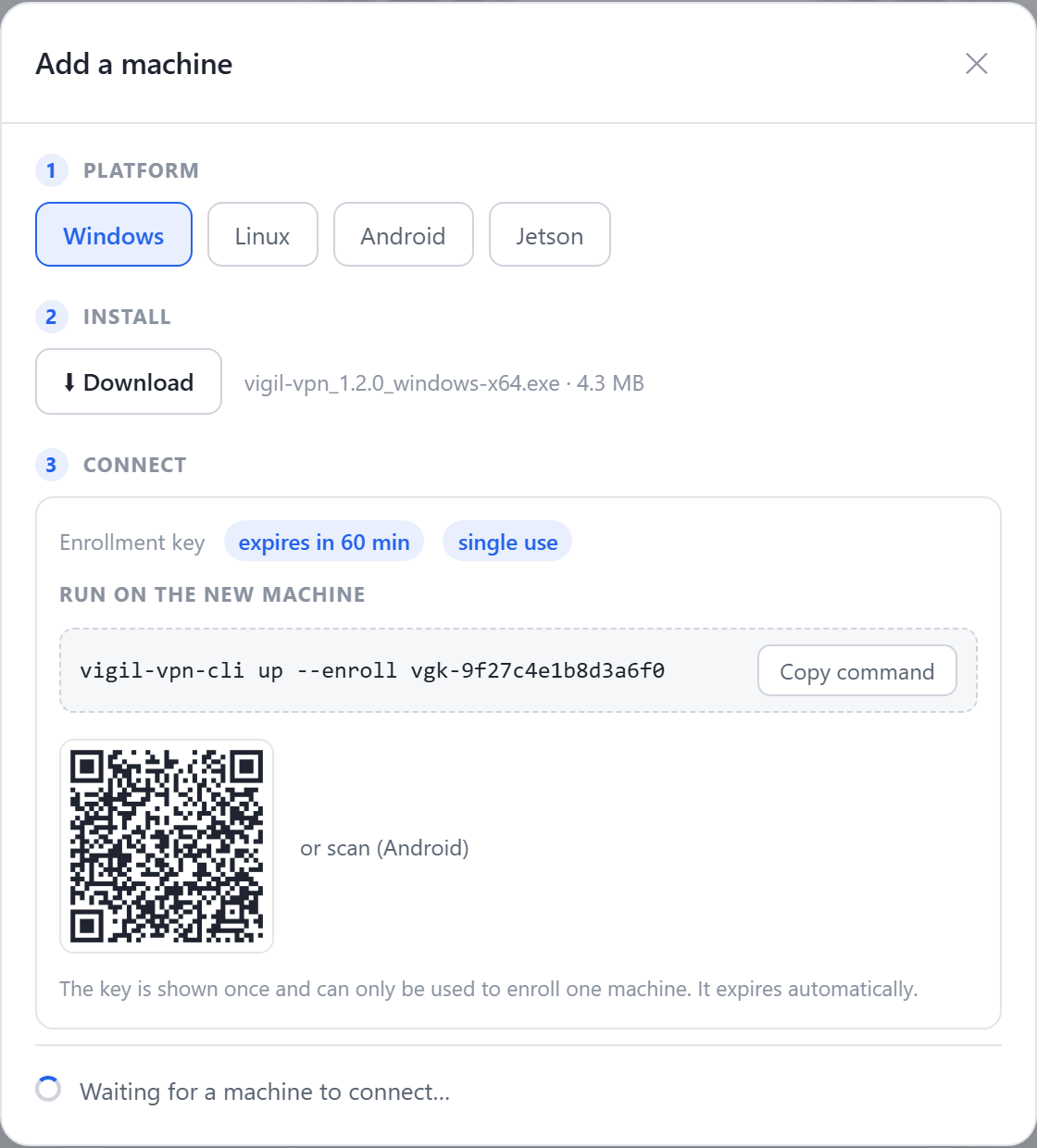
- Choose the gateway's platform — Windows for an HMI industrial PC, Linux for a site box or a Jetson.
- The enrollment command, ready to copy: one-time key, identity generated on the machine itself.
- The console waits for the machine: as soon as the agent connects (outbound), it appears here.
Frequently asked questions
Can we keep the existing Ewon Cosy boxes during the migration?
Do we need to install anything on the PLC?
What if the machine has no PC and no gateway on its network?
Will my engineering tool (PLC program upload) work?
Does the maintenance traffic go through your servers?
The same network that connects them lets each software announce its capabilities — and an MCP assistant see and operate them, under your control, machine by machine.
Read nextIndustrial remote maintenance →